Garmin spent years raising its game - and now it’s sitting next to Rolex
Garmin spent years proving customer demand before launching MARQ into Swiss watch retail. Here's how it turned brand equity into elevated price points.
Years ago, it was assumed that being successful at work meant taking a hit on personal fitness - not any more. Now it’s about being in the top 1% at work whilst also holding several Strava KOM/QOMs. For Garmin, this overlap of executive and athlete has made it possible to gain entry into one of the most difficult markets in retail: the luxury watch market.
This article explores why Garmin created its MARQ collection. You’ll find out why the brand’s route into luxury watch retail made sense, and how it knew its watches would sell at TAG Heuer prices before committing to the roll-out.
For context, MARQ is Garmin’s range of “luxury smartwatches” that’s sold by Swiss watch retailers for Swiss watch prices. i.e. MARQ watches are currently listed on Goldsmiths for between £1,600 and £2,800, where the Tag Heuer Connected Calibre starts at £1,350.
Ultimately, this is a lesson about reading and testing how customer relate to your brand, and capturing the commercial value of brand equity.
Garmin might not have hundreds of years of heritage, but everyone starts somewhere
Garmin was founded in 1989. Its first commercial product came the following year - the GPS 100, a panel-mounted aviation and marine GPS receiver. Priced at $2,500 (roughly £1,300 in 1990), it generated a backlog of around 5,000 orders after debuting at the 1990 International Marine Technology Exposition in Chicago.
It spent the next decade building for aviation, floated on NASDAQ in December 2000, and pushed into automotive GPS in 2001. It didn’t enter health and fitness until 2003, when it launched the Forerunner 201 - the world’s first GPS running watch. Edge cycling computers followed in 2006, and the first fēnix arrived in 2012 to serve outdoor enthusiasts.
Garmin still has a presence in automotive, marine and aviation, but per Garmin’s own 2025 annual report, Fitness and Outdoor together accounted for 61% of total net sales - Fitness at 33%, Outdoor at 28%.
If you look at the patterns, you’ll notice that Garmin’s backstory echoes the more traditional luxury watch houses more than you’d expect. Breitling started by making industrial, military and athletic measurement instruments, not wristwatches. The difference is how long it’s been around. After all, Longines, IWC and Rolex have been doing this since 1832, 1868 and 1905 respectively.
I can already hear the rebuttal’s of, “Garmin’s only been around since 1989, that’s not Swiss-watch worthy”, but the thing to remember is that even the world’s oldest watchmaker - Blancpain, founded in 1735 - was once only 37-years old.
Added to this timeframe point, luxury is defined by customers’ relationships to your products, not time on feet. This is what lifted Garmin to new heights, helping it to pull off a move that’s notoriously hard to make.
Garmin’s elevation strategy worked because fitness is a proxy for professional capability
Somewhere in the last decade, physical performance stopped being a conversation that was limited to chats with friends, and only really talked about during evenings and weekends when you were with people who also shared your fitness values. It started infiltrating the workplace and there was a shift in the assumption that senior roles left no room for serious training. The “physical performance and work performance” connection moved toward someone having the discipline to train being a signal of leadership capabilities.
This isn’t me just applying my own agenda and biases - there is actual science to support this connection. Even back in 2015 (4 years before MARQ was launched), a study of S&P 1500 CEOs found that companies led by marathon-running CEOs were valued roughly 5% higher than those led by non-runners.
The study concluded that, “investments which help CEOs cope with the high demands and stress of their job… can be valuable and thus in the interest of shareholders.”
This is just one study, but I could cite another 20 and the conclusion would show the same: the market and the workplace both appear to price fitness as a proxy for success in leading an organisation. Cue the door was wide open for Garmin’s MARQ collection.
Garmin was a signal that executives could wear with their suit
The challenge that executives had is that, despite fitness being used to infer leadership capabilities, it isn’t exactly easy to show it in the boardroom. You can’t swap your Van Cleef & Arpels necklace for your London Marathon medal, and I don’t think putting your Strava times as your Slack status is a good idea. So how are you meant to signal it, in the exact room where you’re meant to get professional payoff?
Your watch is one of the only objects that bridges the gap - it’s discreet enough to be worn under a shirt sleeve, but Garmin’s in particular are distinct enough that you get a knowing nod even if it’s only peeking out from under your cuff. And if no-one sees it, the strength of the association is still there. You’re not missing daytime data, so you can make training decisions based on complete information - bear in mind you’re performance focused.
The problem that Garmin had with a customer wanting to wear their watch all day, was the aesthetic. It knew that it had a customer who was having to decide between wearing their Rolex Daytona - with its steel bracelet and slim profile - and their chunky, plastic-strap Garmin Forerunner 920XT.
And I say that from my own lived experience. Around 2015, I had friends in finance - nothing to do with the sports industry - who were living and breathing performance sport. One was training IronMan while also being CFO of a multimillion pound property portfolio. Another was an Age Grouper and CEO of a FTSE100 FMCG business. When they were working from home or it was “dress down Friday”, it was a Garmin day. Board meetings? They’d swap to their respective Rolex and AP.
Another piece of anec-data is that the aesthetic friction - preventing Garmin' customers from wearing their watch at work - was also a recurring topic in customer feedback.
The point is that Garmin wasn’t inventing demand for a Swiss-watch alternative. Demand already existed, qualitatively at least. The next step was to measure it, to check it would work commercially.
Garmin applied progressive overload to its prices (and the quality of its products)
The first test was pricing. Would people really spend more money on a Garmin watch? This needed to be validated to then unlock Swiss-watch level material upgrades, otherwise it’d be compromising margin for brand presence.
Between 2003 and 2018, Garmin steadily raised its prices. The clearest step came in 2016, when it began using premium materials in existing product lines. It also started adjusting its product narrative - per Garmin’s own fēnix 3 launch copy, which described a watch that “suits both the outdoors and the boardroom”.
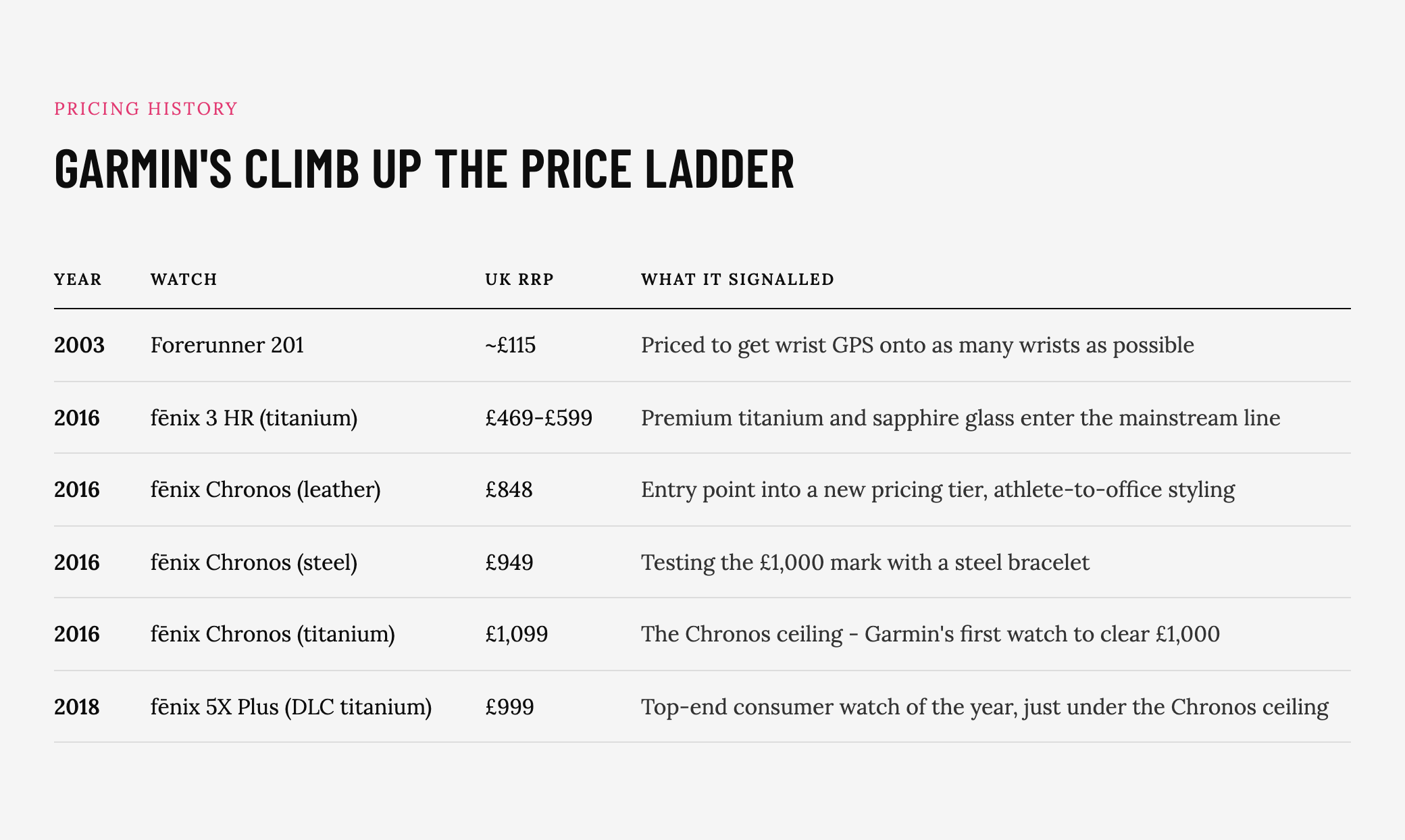
To show the pricing changes, I’ve focused on 2016 because it’s where prices nearly doubled when Garmin started swapping plastic and silicone for steel, titanium and leather. It’s also when the brand had enough watches in the market, stretched across a wide enough range of prices, that it’s clear it was testing the signals that customers valued the brand more than the earlier product range had considered. The pricing was about whether this would translate into them putting in the same vote of support with their wallets.
The Chronos Titanium was Garmin’s first watch to cross £1,000, laying the groundwork for MARQ. It wasn’t built on the same production logic as Garmin’s mainstream range - it was constructed from forged titanium, a custom-brushed link bracelet, came in higher-end packaging, and was produced in smaller numbers than the standard fēnix line. It was sold mainly through Garmin’s own retail network, and according to DC Rainmaker, it also found its way into a handful of high-end watch shops. Slowly but surely Garmin was testing different customer signals, gauging the sweet spot between brand equity and commercial value.
Having pushed past £1,000 with Chronos, Garmin then confirmed it could lift its mainstream sports-retail pricing to a similar level with the 2018 fēnix 5X Plus. This was positioned more as consumer tech than a luxury signal, and capped just under the thousand-pound mark rather than above it.
One year later, in 2019, Garmin formally split its lineup with fēnix at the top end of consumer sports retail, and MARQ for high-end watch specialists and jewellers.
Where brand equity meets financial payback
Earlier I mentioned the spread of prices across 2016 watches. Notice that, by 2018, customers were already paying up to £999 for a Garmin through ordinary retail. The sequence showing that it’s entry into the luxury watch category happened after it knew it could sell products, in the right volumes, at the right price point.
This was particularly important given MARQ was going to be sold purely through high-end luxury watch and jewellery specialists - Garmin couldn’t afford to compromise the sports and outdoor retailers who were creating the brand exposure and revenues that helped generate the majority of its global revenue.
When MARQ launched in 2019, creative lead Todd Register was completely transparent about the brand’s intentions. He said that MARQ was “designed to be sold alongside luxury Swiss watches.” And having tested higher quality materials with Chronos, Garmin knew it could invest in matching the material standards set by its new brand neighbours. i.e. a titanium case, domed sapphire crystal glass, and a ceramic bezel.
All of this investment in time, design and materials paid off, and by 2021, Garmin was reporting that its high-end watch and jewellery specialist network was helping it to achieve triple-digit growth and a rising average selling price.
The lesson is in sequencing, identity, and listening to consumer signals
Garmin didn’t invent belief that it belonged next to Tag Heuer and Rolex. Instead, it read the signals from its customers - then backed qualitative observations with hard commercial data.
The key lesson is that successful elevation comes from knowing your customers. You have to understand who they are, and who you are relative to them and their identity, And if they’re giving you signals that you’re worth more to them, make sure that you’ve got a data-driven plan to check that you’ve earned enough brand equity to earn a higher price.
This content is produced for informational purposes. It does not constitute specific business, commercial, or investment advice for any individual organisation. For specific business guidance, please get in touch suzannah@strongbrandstrongbusiness.com.